The Origin of Christmas - Myths and Little Known Facts
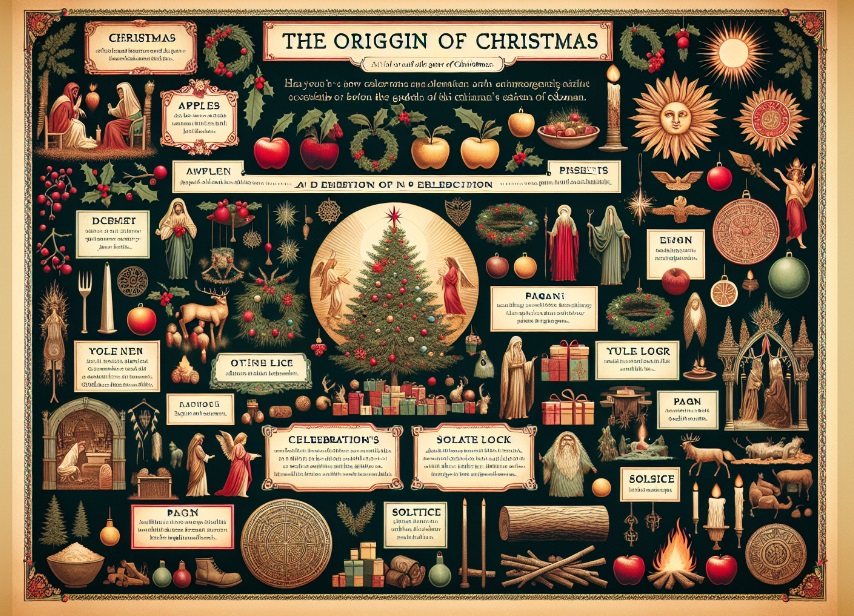
The origin of Christmas: A rich tapestry woven from various cultural, religious, and historical threads. Discover myths and little-known facts about this festive holiday.
The origin of Christmas stemmed from pagan festivals like Winter Solstice and Yule. In the early pre-Christian era, European winter celebrations were very popular and followed pagan rituals that celebrated the darkest days of winter.
Paganism and it's impact on Christmas
Paganism observes the ancient and modern religions that identify with nature as the body of the Divine and include the religions of ancient Greece and Rome, and the Northern European countries.
The worship of multiple Gods and Goddesses are common in their celebrations.
Early Europeans observed the shortest day --- Winter Solstice --- to celebrate the worst of the winter being over them as they look ahead to increased daylight hours. During this celebration, they killed their livestock that would not survive the winter and gorged on them from late December through January.
At this time there was the celebration by Scandinavians and Germans of the Yule season which runs for 13 days and begins the night before Winter Solstice.
In Germany, Odin was celebrated by many who viewed the pagan God as a fat, gift giving Elf who flew over houses during the night bestowing good tidings on people that were nice and bad tidings on others. Another tradition during Yule was the burning of the Yule Log from a giant tree that was to protect the house from storms and bring it good luck throughout the year.
Christ Wasn't Born on December 25th
While Christmas celebrates the birth of Jesus Christ, many elements of the holiday, such as the timing and some traditions, predate Christianity. For example, the date of December 25th was chosen to coincide with pagan festivals celebrating the winter solstice.
No one knows the birth date of Christ, or even what year. Christ, according to many historians was born in the springtime. Nowhere in the New Testament do we see Christ's disciples observing His birthday. The apostles did not honor pagan rituals, and accordingly, preached to other Christians to avoid the pagan rituals.
Many religious scholars believe that Jesus probably was born in the Spring or Autumn, and most likely in the Spring.
During the chilly winter months, it's doubtful that sheep would be roaming the hills when snow dominates much of the landscape.
Also, during the spring, the Jewish festival called 'Passover' is celebrated with Jews from all over the Roman Empire traveling to Jerusalem for the Passover Festival. Because of the heavy concentration of Jews in Jerusalem at this time of the year, it is believed that the Romans chose this time for the taking of a census. Mary and Joseph went to Bethlehem for the census, several miles from Jerusalem.
The Origin of Christmas Took Place in 350 AD
In the year In 350 A.D., Pope Julius I declared the birth and celebration of Christ's birthday as Christmas and chose December 25th because it coincided with the popular pagan traditions of Winter Solstice. The purpose was to replace the pagan celebrations with the Christian one. It worked, and it worked extremely well!
Could this be one of the most creative and successful marketing strategies ever implemented?
It certainly has all the ingredients of a sound marketing plan including competitive analysis, packaging, branding, product differentiation, and promotion.
Most Christmas customs, the decorating the evergreen "Christmas" tree, the hanging of mistletoe, gift exchanges, and Santa Claus, all came from pagan winter practices and secular traditions that were celebrated throughout Europe.
Santa Claus is based solely on St. Nicholas. While St. Nicholas, a 4th-century bishop known for his generosity, did inspire some aspects of the modern Santa Claus, the figure has also been influenced by folklore from various cultures, including Norse mythology and the Dutch Sinterklaas.
Christmas as we know it today, is not only a mix of ancient pagan practices and hundreds of years of adopting secular and religious traditions, it also has a Victorian period influence that affected the practice and acceptance of Christmas.
The term "Xmas" has historical significance. The "X" in Xmas comes from the Greek letter chi, which is the first letter of "Christ." Thus, "Xmas" is not a secularization of Christmas but rather has deep roots in Christian tradition.
The US Federal Government Declares Christmas a Secular Holiday
While Christmas wasn't declared a federal holiday in the US until June 26, 1870, on December 6, 1999, federal U.S. District Judge Susan J. Dlott ruled that Christmas has become so secular that the government does not violate the Constitution by declaring it a federal legal holiday.
Christmas has the distinction of being a multi-cultural, multi-religious and secular holiday. It is celebrated throughout the world, and in the US, over 90% of the population celebrates Christmas. Depending on national and local customs, it integrates sun worship, polytheism, pagan nature religions, Christianity, and other later myths and traditions.
Since Christmas has the distinction of being a multi-cultural, multi-religious and secular holiday --- wishing someone a "Merry Christmas" is about expressing your best wishes for their enjoyment of a day off from work to join in on the celebration of a national, non-religious holiday.
These wishes are therefore politically correct, regardless of whether they are directed to Christians, Jews, Muslims, Buddhists, or atheists.
Christmas as a multi-cultural,
multi-religious and secular holiday
Christmas has become a commercialized celebration throuugh the world with many mass-produced symbols, decorations, and gifts manufactured in less developed countries and sold throughout the world.
The all-time top 25 Christmas carols recorded and played on TV, the radio, and in the malls, are the works of Jewish songwriters. Some popular songs include; White Christmas, O' Holy Night, The Christmas Song, He's a mean one Mr. Grinch, Rudolph the Red-Nosed Reindeer, Rockin Around the Christmas Tree, Have A Holly Jolly Christmas, and Silver Bells.
Everyone enjoys the celebration of Christmas! The non-religious celebrate the joyous traditions. The Christians, who believe that Christmas and its rituals solely relate to the birth of Christ, celebrate the religious rituals. The pagans celebrate the rituals of Winter Solstice and Yule.
What about all the people who each year are given a paid day off from work for having Christmas as a legal holiday, regardless of their beliefs?
Having taken all this in, why all the fuss about changing the greeting "Merry Christmas" to "Happy Holidays"?
The origins and traditions of Christmas are diverse and layered, reflecting a blend of religious, cultural, and historical influences. Understanding these roots allows us to appreciate the holiday's multifaceted nature and the various ways it is celebrated around the world today.
Christmas in New Jersey
Guide to NJ's Top 2024 Christmas Events with
Tree Lighting Celebrations, Festivals, and Parades

Best New Jersey Restaurants Open Christmas!
Discover restaurants with outstanding food and holiday ambiance and are open Christmas Eve & Christmas Day.

Ultimate Guide to New Jersey's Christmas Tree Farms!
Discover NJ's top Chose and Cut Christmas tree farms for 2024

December In New Jersey: Top 10 Things To Do!
Discover NJ's top seasonal Attractions, Hidden Gems, and things to do.

Ring in 2025: Top New Jersey New Year's Celebrations!
Discover the best NJ New Year's Eve Parties. held in hotels and banquet venues.